

I. Transformation and Demand Upgrade in the Global Apparel Market
Amid the accelerating iteration of fast fashion and the vigorous development of cross-border e-commerce, the global apparel industry is undergoing profound changes. Brands and retailers are faced with the dual demands of “cost reduction through bulk production” and “market expansion through global layout”: on the one hand, they need stable bulk clothing manufacturers to provide cost-effective and high-quality ready-to-wear supplies to support large-scale sales; on the other hand, they urgently require reliable global apparel suppliers to break through barriers in cross-border logistics, localized services, and other links, solving the chain gap from “production end” to “consumer end”. According to Statista, the global apparel market size exceeded 1.7 trillion US dollars in 2023, with cross-border apparel trade accounting for 35%. This trend has directly driven the rise of the integrated service model of “bulk manufacturing + global supply” — which can not only control costs through large-scale production but also reach end consumers through a global network, becoming the core paradigm of cooperation in the apparel industry.
II. Core Competitiveness of Bulk Clothing Manufacturers
As the source of the apparel supply chain, professional bulk clothing manufacturers are the cornerstone of the global supply system, with core advantages reflected in three dimensions:
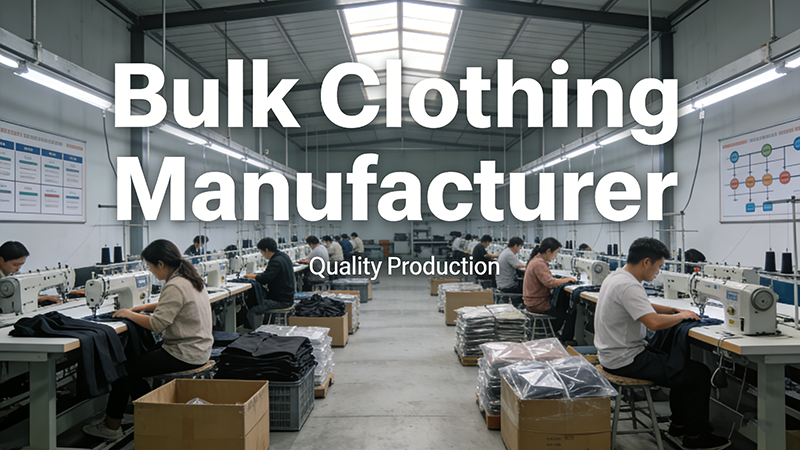
- Large-scale Production and Cost Control:Relying on modern production bases (usually equipped with 50+ production lines and a daily capacity of 100,000+ pieces), through centralized fabric procurement, automated cutting equipment, and assembly line operations, significant reduction in unit costs is achieved. Taking basic T-shirts as an example, the fabric waste rate of bulk production can be controlled within 3%, 60% lower than that of small workshops, reserving sufficient profit margins for customers.
- Full-link Quality Control System:Establish a multi-dimensional quality control system from fabric selection to finished product delivery. In the fabric link, cooperate with top global fabric suppliers and obtain OEKO-TEX 100 environmental certification; implement the “three-inspection system” (first-piece inspection, patrol inspection, final inspection) during production, strictly following the AQL 2.5 quality standard; before delivery, finished products must pass 12 indicators such as shrinkage rate, color fastness, and tensile strength to ensure consistent quality of bulk orders.
- Flexible Customization and Rapid Response:Break the misunderstanding that “bulk production = rigid design” and support full-dimensional customization from fabric, pattern, version to size. For small and medium-sized brands, it can provide minimum order quantity of 500 pieces/style for trial orders, combined with a fast sampling cycle of 7-15 days, meeting the “small-batch and quick-response” needs of fast fashion brands.
III. Link Integration Capabilities of Global Apparel Suppliers
If bulk manufacturing is “product strength”, then global supply is “delivery capability”. Professional global apparel suppliers need to possess three core capabilities:
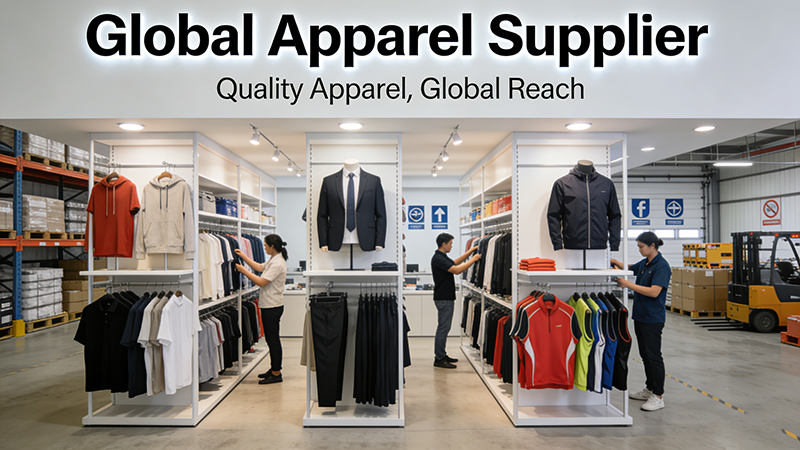
- Coverage of Cross-border Logistics Network:In-depth cooperation with international logistics giants such as DHL, FedEx, and Maersk to establish a trinity logistics system of “air transportation + sea transportation + overseas warehouses”. Covering 30+ core markets including Europe, America, Southeast Asia, and the Middle East, among which Europe and America can achieve delivery within 3-7 days, and Southeast Asia within 2-5 days, solving the pain points of slow cross-border transportation and high costs.
- Localized Services and Compliance Guarantee:Set up overseas service centers in core cities such as Los Angeles, Hamburg, and Singapore, providing integrated services including customs clearance assistance, local distribution, and after-sales return and exchange. At the same time, familiar with the compliance standards of the apparel industry in various countries (such as EU REACH regulations, US CPSIA certification), proactively avoiding tariff barriers and quality certification risks to ensure smooth customs clearance of goods.
- Digital Supply Chain Management:Realize full-process visualization of orders through ERP systems, allowing customers to track production progress and logistics status in real time; establish a global database of fabric and auxiliary material procurement, integrating resources of 200+ high-quality suppliers to achieve “one-order placement, global deployment”, significantly shortening the supply chain cycle.
IV. Integrated Services: Creating Dual Value for Customers
When the identities of bulk clothing manufacturer and global apparel supplier are integrated, it will bring “1+1>2″ cooperation value to customers:
- Cost Optimization:Through seamless connection of “manufacturing + supply”, reduce intermediate agent links, enabling customers to reduce procurement costs by 15%-25%; the economies of scale from bulk production combined with the bargaining power of global logistics further compress comprehensive costs.
- Efficiency Improvement:The full-link cycle from design sampling, bulk production to global distribution is shortened to 20-45 days, saving 30% of the time compared with the traditional “manufacturing + third-party logistics” model, helping brands quickly respond to market hotspots.
- Risk Control:Unified quality control standards and compliance management avoid quality problems and customs clearance delays caused by disjointed production and supply; flexible logistics solutions (such as emergency sea-to-air transportation) can cope with sudden supply chain situations.
A cooperation case of a cross-border apparel e-commerce platform confirms this value: through cooperation with an integrated service provider, its bulk procurement cost is reduced by 20%, cross-border delivery time is shortened from 15 days to 5 days, customer repurchase rate is increased by 35%, and 12 new overseas market layouts are added within half a year.
V. Sustainable Development: The Future Direction of the Global Apparel Supply Chain
Against the background that ESG concepts have become industry consensus, both bulk manufacturing and global supply links are transitioning to green development. As a responsible service provider, we fulfill our sustainability commitments in two aspects:
- Green Production:Introduce solar power generation systems, reducing energy consumption in the production process by 18%; adopt environmentally friendly materials such as recycled cotton and degradable fabrics, with the utilization rate of environmentally friendly fabrics reaching 40% in 2023; optimize production processes to reduce wastewater discharge and fabric waste.
- Low-Carbon Logistics:Prioritize low-carbon transportation methods such as sea transportation, combined with carbon offset projects; promote recyclable packaging materials to reduce the use of disposable packaging; reduce paper documents through supply chain digitalization to achieve “paperless office”.
In the future, competition in the apparel industry will be the competition of supply chain integration capabilities. Whether it is the production strength of bulk clothing manufacturers or the link capabilities of global apparel suppliers, they will ultimately return to the core of “customer-centricity” — through integrated services, helping brands focus on design and marketing, and achieving the core goals of “cost reduction, efficiency improvement, and market expansion”.
Post time: Mar-24-2026